Helmet Therapy
In cases of cranial deformities, a cranial remodeling orthosis can provide aesthetic improvement when used at the right time and in the right cases.
Prof. Dr. Alp Özgün Börcek
Neurosurgery
Ankara Güven Hastanesi
You can schedule an appointment for an evaluation of your baby’s helmet therapy or abnormal head shape.
Schedule an Appointment via WhatsApp Contact
Prof. Dr. Alp Özgün Börcek
Neurosurgery
Ankara Güven Hastanesi
This content is for informational purposes only; a medical examination is required for diagnosis and treatment. Medical texts must be reviewed by a doctor.
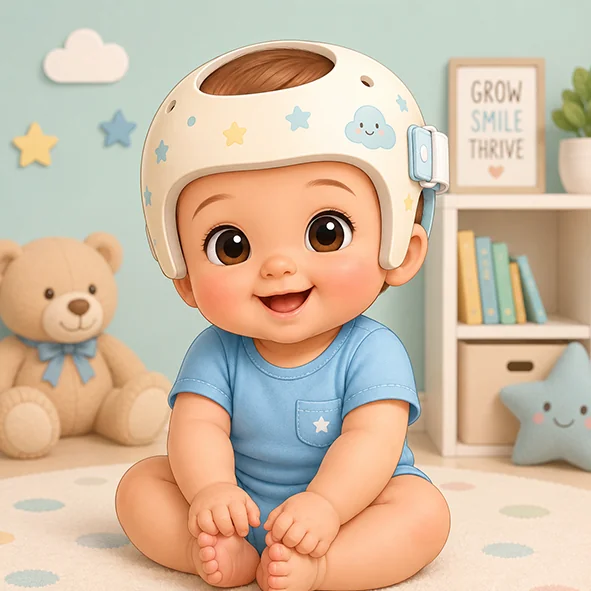
Helmet therapy (cranial orthosis), used to treat head shape abnormalities in infants, can be both a source of hope and a source of uncertainty for parents. Prepared in light of current scientific research and clinical protocols, this comprehensive guide summarizes the key aspects of helmet therapy.
Prof. Dr. Alp Özgün Börcek conducts evaluations of abnormal head shape and helmet therapy as part of pediatric neurosurgery at Ankara Güven Hastanesi. An examination is required to determine a personalized diagnosis and treatment plan.
What Is Helmet Therapy (Cranial Orthosis)?
helmet therapy, medically known as cranial remodeling orthosis, is a custom-designed medical device used to help the baby’s rapidly growing skull achieve a more symmetrical shape.
Helmets do not reshape the head by squeezing it, as is commonly believed; rather, they guide the skull’s natural growth by leaving space for growth in the flatter areas of the head while gently limiting growth in the more prominent areas.
What Causes It? Head Shape Abnormalities
The bones of a baby’s skull are quite flexible during birth and in the first few months afterward. This flexibility not only facilitates passage through the birth canal but also allows for the growth of the brain, whose volume increases approximately threefold during the first year. However, this softness also makes the skull vulnerable to external pressure.
- plagiocephaly: This condition is characterized by one side of the head being flatter than the other and the ears not being aligned. For more information, positional plagiocephaly You can check out the page.
- brachycephaly: It is a condition in which the back of the head becomes completely flat, making the skull appear wider than normal.
Reasons: In multiple pregnancies, causes include crowding in the uterus, difficult labor (such as the use of a vacuum extractor), and, most commonly, the baby being kept in the same position for an extended period. In addition, tension in the neck muscles (torticollis) can cause the baby to constantly turn its head in one direction, which may trigger the flattening of the head.
Important: craniosynostosis (premature suture closure) cannot be corrected with helmet therapy; it requires surgical evaluation.
When Is Treatment Necessary?
Not every cranial deformity requires helmet therapy. In mild cases, positional therapy (changing the sleeping position) and physical therapy are usually sufficient. Specialists consider helmet therapy in the following situations:
- Severity level: In moderate to severe cases, such as when asymmetry (CVAI) exceeds 10% or the head index exceeds 100%.
- Age factor: The period when skull growth is fastest 4 to 8 months This is the most effective period for helmet therapy. After 12 months, the skull begins to harden and growth slows down, so the helmet’s effectiveness decreases significantly.
- Failure of conservative treatment: No improvement despite position changes and physical therapy lasting at least 2 months.
In the early stages fontanelle and suture assessment It also plays an important role in head shape planning.
What Does Scientific Research Say?
Studies on the effectiveness of helmet therapy have yielded mixed results:
Johns Hopkins University study: A study conducted on more than 4,000 infants showed that helmet therapy resulted in a 94.4% rate of complete recovery when used as the first-line treatment. It was found that methods such as repositioning were successful in approximately 77% of cases, but the remaining infants still required a helmet.
The Netherlands HEADS Study: The study suggested that there is no significant difference around the age of 2 between the use of helmets and no intervention in healthy infants. However, since this study did not include infants with very severe cases or accompanying medical conditions, its findings cannot be generalized to every case.
Research from Germany: It confirms that early diagnosis and intervention lead to more favorable outcomes, particularly in infants with ear displacement and severe asymmetry, and that the chances of recovery decrease as the child gets older.
What Happens If We Don't Wear a Helmet?
Scientific studies on the potential consequences of not wearing a helmet provide important data regarding both the natural healing process and long-term aesthetic outcomes. Based on the available sources, the answer to this question can be summarized under the following headings:
1. Brain Development and Its Impact on Health
One of the most critical findings is that positional plagiocephaly has no adverse effect on the infant’s brain development, mental health, or neurological functions. This condition is medically considered primarily a cosmetic issue, and the use of a helmet does not restrict or impair brain growth.
2. The Natural Healing Process (Self-Healing)
As babies grow, their muscle strength increases, and they become more mobile and begin spending time on their stomachs, the flattening of the head typically improves on its own. In a comprehensive scientific study conducted in the Netherlands called HEADS, the head shapes of 2-year-old infants who wore helmets were compared to those of infants who received no active treatment, and no significant difference was found between the two groups.
3. Full Recovery Rates and Aesthetic Concerns
Even without wearing a helmet, the shape of the head may improve; however, it may not always return to a completely normal shape:
- Risk of permanent deformation: In the study, 25.6% of infants who wore helmets showed complete recovery, while this rate was found to be 22.5% among infants who received no treatment. Approximately 75% of the infants in both groups still had some degree of flattening at age 2.
- The future of aesthetic perception: Some studies argue that the shape of the head will correct itself to an acceptable degree as the child grows; however, there are also individuals who experience aesthetic discomfort in adulthood due to asymmetries dating back to infancy. Parental concerns regarding the potential for deformities during infancy to lead to self-esteem issues and psychosocial effects later in life are documented in the literature.
- Functional issues: Although rare, it is noted that if severe asymmetry is left untreated, it can lead to functional problems such as abnormal jaw development, vision problems, or misalignment of the ears and eyes.
4. The Success of Alternative Methods
When a helmet is not worn, the most effective approach is positional therapy and physical therapy. Studies have shown that complete correction can be achieved in 77.1% of infants through proper position changes and tummy time activities alone. Especially in cases where the asymmetry is mild or moderate, physical therapy methods are generally sufficient instead of a helmet.
In summary: If a helmet is not worn, your baby’s brain development will not be harmed, and the head shape can largely correct itself. However, in severe cases, not using a helmet can lead to permanent asymmetry and may result in the person being dissatisfied with their head shape in adulthood. When making a decision, the severity of the condition and the family’s aesthetic expectations are the most decisive factors.
How to Put on a Helmet and How to Use It
When the decision is made to undergo helmet therapy, a digital model of the baby’s head is created using 3D scanning techniques.
- Service life: For best results, wear the helmet every day 23 hours It is mandatory to wear a helmet. The remaining hour is set aside for cleaning the helmet and bathing the baby.
- Exercise program: Babies usually get used to their helmets within a week. Start by having them wear it for 1 hour and then taking it off for 1 hour on the first day; increase the wearing time each day until, by the 6th or 7th day, they are ready for full-time use, including while sleeping.
- Checks: As the baby grows, clinic checkups are scheduled every 2–4 weeks to adjust the gaps inside the helmet. Treatment generally 3 to 6 months is completed between them.
Challenges and Side Effects Encountered
helmet therapy may present some practical challenges for families and infants:
- Excessive sweating: Because babies lose heat through their scalps, wearing a helmet can cause excessive sweating during the first few weeks. Approximately 70% of families report this issue.
- Skin irritation: Redness and irritation may occur as a result of the helmet coming into contact with the skin or due to sweating. Skin problems—even if mild—have been reported in 96% of cases.
- Bad smell: Sweat buildup can cause odors in the helmet; therefore, it should be thoroughly cleaned every day.
- Social factors: Some parents may feel that the sensation of hugging is restricted when wearing a helmet. Since helmets are custom-made, they are expensive pieces of equipment.
Important Maintenance Notes
- Skin check: Every time the helmet is removed, check the baby’s skin for pressure marks.
- Hygiene: The baby's hair should be washed every day; do not apply lotion or ointment to the scalp.
- Cleaning: The inside of the helmet should be disinfected daily by brushing it with a soft toothbrush and alcohol.
Conclusion
helmet therapy is a method that can lead to significant aesthetic improvements when used at the right time and for the right condition. However, before starting helmet therapy, positional exercises and time spent on one's stomach Regular "tummy time" activities may allow most babies to recover without needing a helmet.
You can schedule an appointment for an evaluation of helmet therapy or abnormal head shape.
Schedule an Appointment via WhatsApp ContactRelated Pages


Frequently Asked Questions
No. The helmet leaves room for growth in the flatter areas and guides growth in the more prominent areas.
For best results, it is generally recommended to wear it for 23 hours a day; the remaining time is for cleaning and bathing.
The most effective period is between 4 and 8 months. After 12 months, effectiveness decreases significantly because the skull has hardened.
No. In mild cases, changing positions and physical therapy may be sufficient.
Sweating and mild skin redness are usually temporary; regular skin checks and good hygiene are important.
No. craniosynostosis requires surgical evaluation; a helmet is considered for positional plagiocephaly and brachycephaly.
If there is no response to conservative treatment after at least 2 months, helmet therapy is considered for moderate-to-severe cases.
Most treatments are completed within 3–6 months; the helmet is adjusted during follow-up visits every 2–4 weeks.
Author: Prof. Dr. Alp Özgün Börcek
Last updated: July 4, 2026
This content is provided for informational purposes only; it is not intended to replace a personal diagnosis or treatment.